Find a Medicare Part D prescription drug plan

Medicare Part D
Prescription Drug Coverage
Medicare Part D Plans
Reviewed by Russell Noga, Licensed Medicare Insurance Broker (all 50 states) — Last updated September 16, 2026
Medicare Part D plans are prescription drug coverage, sold by private insurance companies and approved by Medicare. Original Medicare — Part A and Part B — does not cover most prescriptions you pick up at a pharmacy. Part D is how that gap gets filled, and roughly nine out of ten people with Medicare carry it in one form or another.
Because private insurers set the terms, no two plans are identical. Premiums, deductibles, which drugs are covered and which pharmacies give you the best price all vary by plan and by county. This page explains how the coverage works, what it costs, when you can sign up, and how to pick the plan that is cheapest for the specific medications you take.
⚑Shopping for 2027 coverage?
Enrollment for 2027 plans runs October 15 to December 7, 2026, with coverage starting January 1. Costs are changing: the deductible rises to $700, the out-of-pocket cap rises to $2,400, and two temporary price protections that held standalone plan premiums down both expire on December 31, 2026.
Key Takeaways
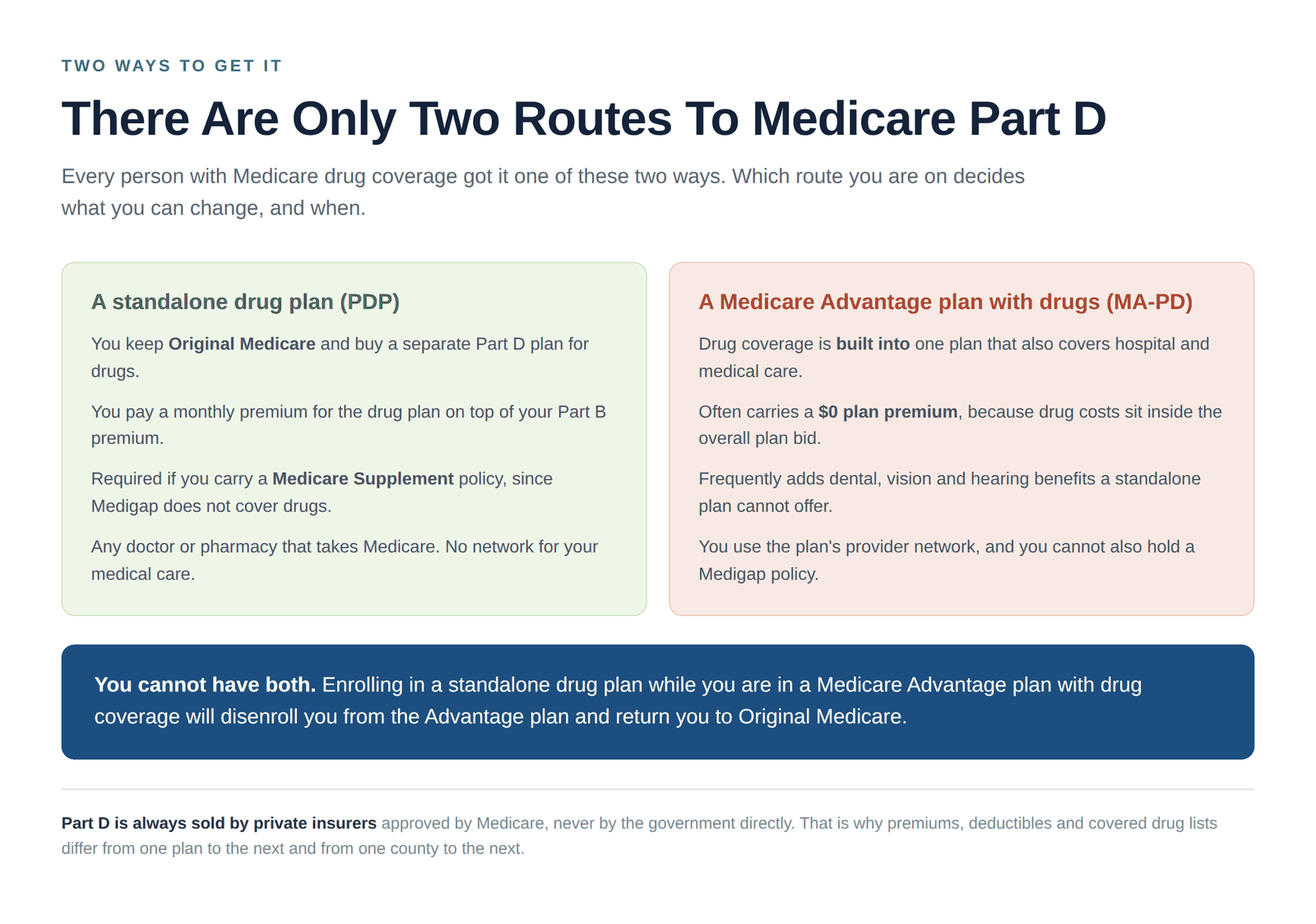
- There are only two ways to get Part D: a standalone drug plan alongside Original Medicare, or a Medicare Advantage plan with drug coverage built in. You cannot have both.
- Four numbers decide your cost: the monthly premium, the annual deductible, your copay or coinsurance per prescription, and the annual out-of-pocket cap.
- The coverage gap, known as the donut hole, was eliminated in 2025 and no longer exists.
- Once your out-of-pocket spending reaches the annual cap — $2,100 in 2026, rising to $2,400 in 2027 — covered drugs cost you nothing for the rest of the year.
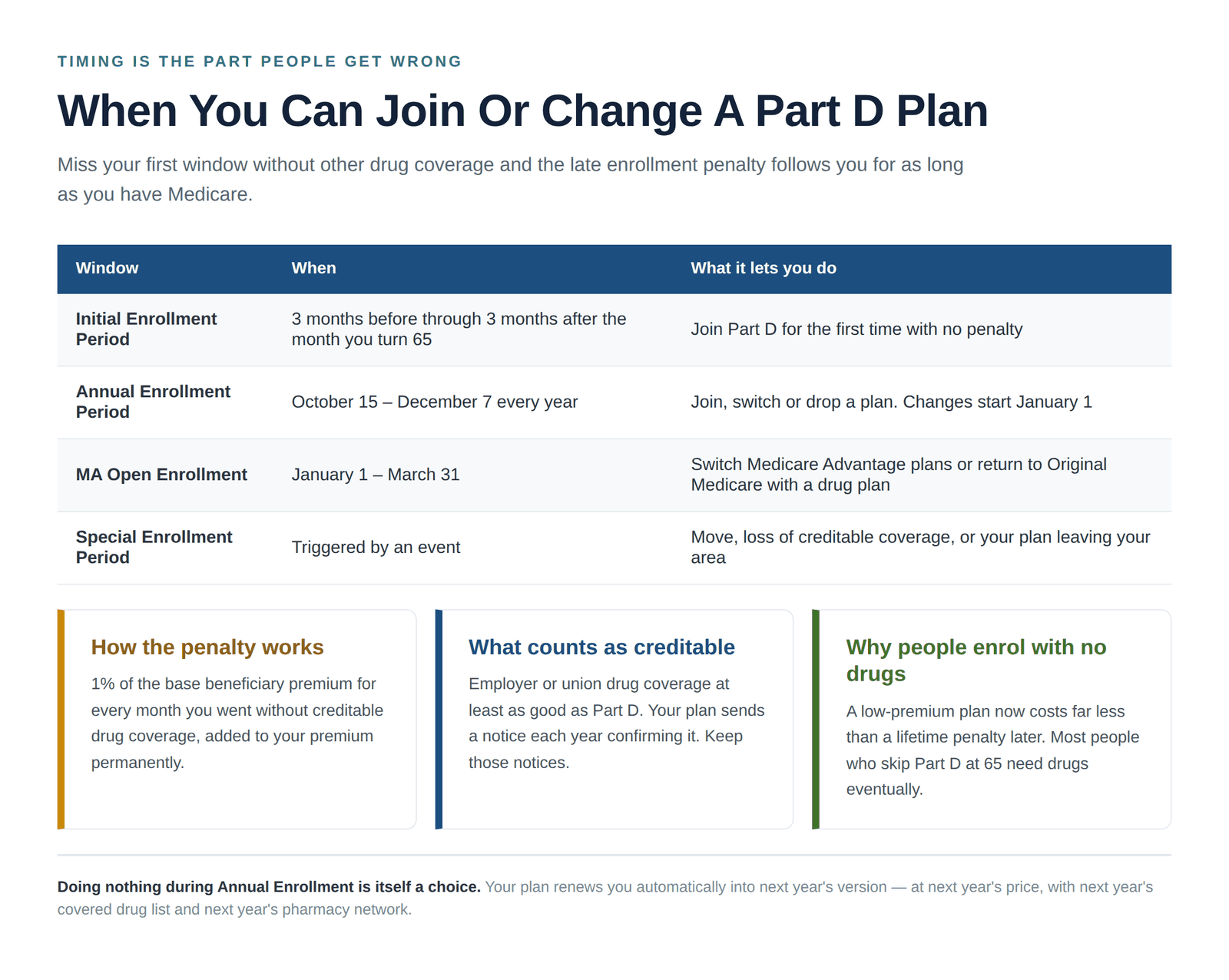
- The Annual Enrollment Period runs October 15 to December 7 every year. Changes take effect January 1.
- Delaying Part D without other creditable drug coverage creates a late enrollment penalty that lasts as long as you have Medicare.
Ready to look at actual plans? You can compare Medicare Part D plans and enroll online in a few minutes, or see what is changing in Medicare Part D plans 2027.
What Are Medicare Part D Plans?
Medicare Part D is the part of Medicare that pays for outpatient prescription drugs. It was added to the program in 2006 and, unlike Part A and Part B, it is not administered by the government directly. Instead, Medicare sets minimum standards and private insurers build plans that meet or exceed them, then sell those plans to you.
That structure is why choice matters so much. Two plans available on the same street can charge different premiums, cover different drugs, place the same drug on different cost tiers, and give you different prices at the same pharmacy. Medicare guarantees a floor of coverage. Everything above that floor is a competitive decision the insurer made.
The Two Types of Medicare Part D Plans
Every person with Medicare drug coverage has it one of two ways. The route you take determines what else your plan covers, whether you have a provider network, and what you are allowed to change during enrollment.
| Standalone drug plan (PDP) | Medicare Advantage with drugs (MA-PD) | |
|---|---|---|
| Works with | Original Medicare (Parts A and B) | Replaces how you receive Parts A and B |
| Covers | Prescription drugs only | Hospital, medical and drugs in one plan |
| Typical premium | A separate monthly premium on top of Part B | Often $0 plan premium, still pay Part B |
| Provider network | None for medical care — any doctor taking Medicare | Yes, an HMO or PPO network |
| Extra benefits | No | Often dental, vision and hearing |
| Works with Medigap | Yes — and it is required, since Medigap does not cover drugs | No — you cannot hold both |
One thing that catches people out
If you are enrolled in a Medicare Advantage plan that includes drug coverage and you sign up for a standalone Part D plan, Medicare will disenroll you from the Advantage plan and return you to Original Medicare. It is not an addition. It is a switch. Check which type you have before you enrol in anything.
What Medicare Part D Plans Cover
Each plan publishes a formulary — the list of drugs it covers — and sorts those drugs into tiers. Tier placement, not the drug itself, is what sets your price. The same medication can sit on tier 2 in one plan and tier 4 in another, and that single difference can be worth hundreds of dollars over a year.
| Tier | What sits there | Your cost |
|---|---|---|
| Tier 1 | Preferred generics | Lowest copay, often a few dollars |
| Tier 2 | Generic drugs | Low copay |
| Tier 3 | Preferred brand-name drugs | Moderate copay |
| Tier 4 | Non-preferred brand-name drugs | High copay or coinsurance |
| Tier 5 | Specialty drugs | Coinsurance, a percentage of the drug’s cost |
Every plan must cover at least two drugs in each therapeutic category, and must cover substantially all drugs in six protected classes: antidepressants, antipsychotics, anticonvulsants, immunosuppressants, cancer drugs and HIV or AIDS medications. Recommended adult vaccines, including shingles, are covered at no cost to you, and covered insulin is capped at $35 per month.
Some drugs are excluded from Part D by law regardless of plan. These include over-the-counter medications, weight loss and weight gain drugs, fertility treatments, cosmetic drugs such as those for hair growth, and drugs for erectile dysfunction when prescribed for that purpose. Drugs administered in a doctor’s office are usually billed under Part B instead. Our guide to what Part D Medicare covers goes through this in more detail.
What Medicare Part D Plans Cost
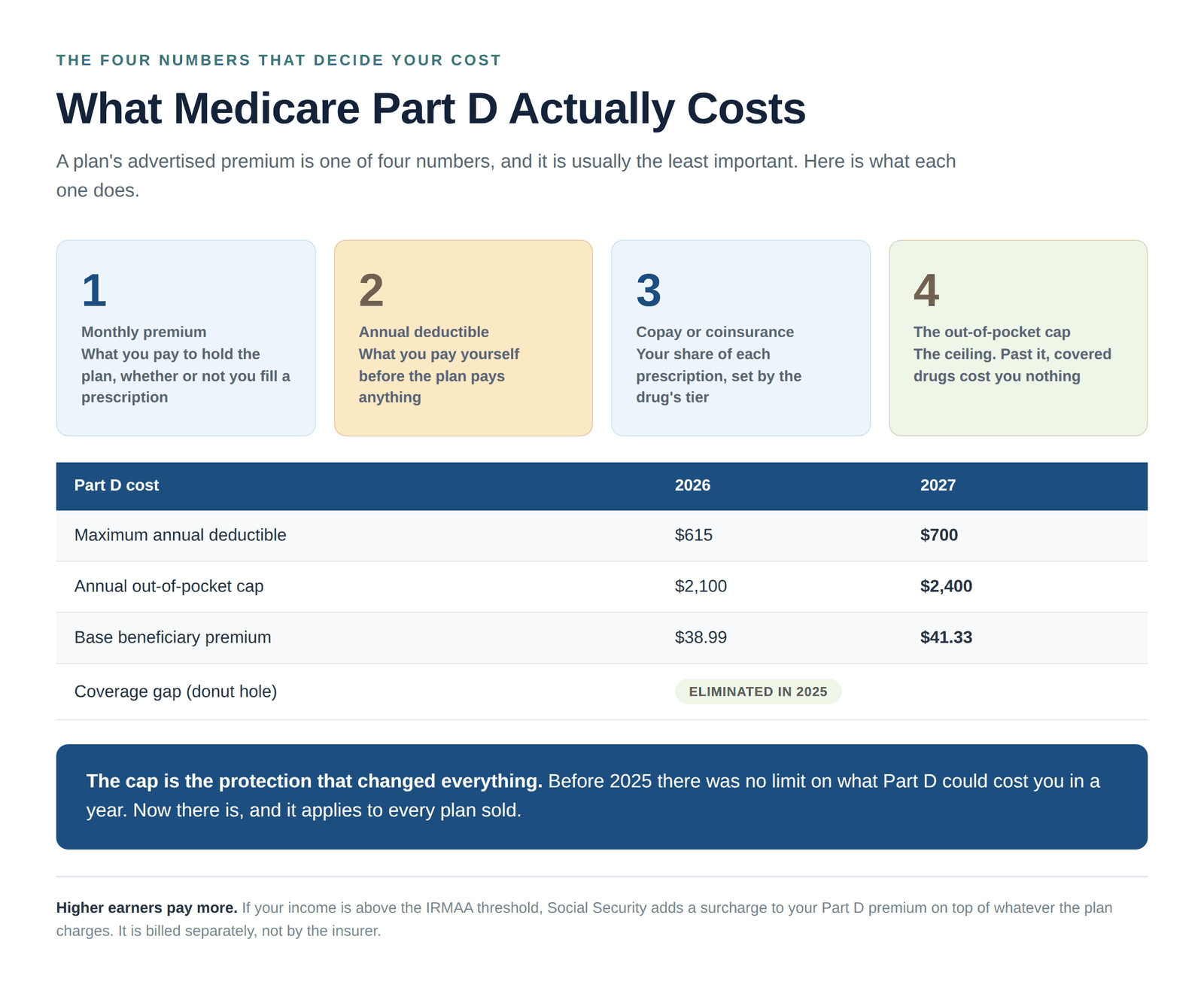
Four numbers determine what a Part D plan costs you. The advertised monthly premium is the one people compare, and it is usually the least important of the four.
1The monthly premium
What you pay to hold the plan, whether or not you fill a single prescription. It is separate from your Part B premium, which you continue to pay. If your income is above the IRMAA threshold, Social Security adds a surcharge on top, billed directly rather than by the insurer.
2The annual deductible
What you pay yourself before the plan starts paying. Medicare caps how high a plan may set it — $615 in 2026 and $700 in 2027 — but plans may charge less, and many waive the deductible entirely on tier 1 and tier 2 generics. See our breakdown of Medicare Part D deductibles.
3Copays and coinsurance
Your share of each prescription once the deductible is met. A copay is a flat dollar amount, coinsurance is a percentage. Which one applies depends on the drug’s tier, and using a preferred pharmacy usually lowers both.
4The annual out-of-pocket cap
The ceiling on what Part D can cost you in a calendar year. Once your out-of-pocket spending reaches it — $2,100 in 2026, $2,400 in 2027 — you pay nothing more for covered drugs until January. No income test, no application. Before 2025 no such limit existed.
| Part D figure | 2026 | 2027 |
|---|---|---|
| Maximum annual deductible | $615 | $700 |
| Annual out-of-pocket cap | $2,100 | $2,400 |
| Base beneficiary premium | $38.99 | $41.33 |
| Coverage gap (donut hole) | Eliminated | Eliminated |
For the full 2027 picture, including why standalone plan premiums are rising, see Medicare Part D plans 2027. For this year’s structure, see Medicare Part D plans 2026.
Find a Plan and Enroll Online Yourself!
Advertisement
How to Compare Medicare Part D Plans
Step 1
List every drug you take
Exact name, exact dosage, exact quantity per month. Without this list you are comparing premiums, and premiums tell you almost nothing about what a plan will actually cost you.
Step 2
Check each drug against the formulary
Confirm the plan covers it at all, then find its tier. A drug your plan does not cover costs you full price, and that spending does not count toward your out-of-pocket cap.
Step 3
Add up the total annual cost
Premium times twelve, plus the deductible, plus your estimated copays across the year. A $0 premium plan that places one of your drugs on tier 4 routinely beats a $40 plan on the sticker and loses badly on the total. Work through a full Medicare Part D plan comparison before deciding.
Step 4
Confirm your pharmacy is preferred
Most plans have a preferred pharmacy tier where your cost sharing is meaningfully lower. Same plan, same drug, different counter, different price. Mail order is often cheaper again on maintenance medications.
Step 5
Check the star rating, then enroll
CMS rates plans from one to five stars on customer service, accuracy and member experience. It is a tiebreaker, not a primary filter. Start with the best rated Medicare Part D plans, then price them against your own list.
Most major insurers offer standalone drug plans, though availability and pricing differ by county. The larger carriers include Humana, Cigna, Aetna and SilverScript, UnitedHealthcare and the regional Blue Cross Blue Shield plans. You can also browse every option under Medicare Part D prescription drug plans.
Help Paying for Medicare Part D Plans
The Low-Income Subsidy, commonly called Extra Help, is the largest cost reduction available in Part D. If you qualify it can cover your monthly premium entirely, eliminate your deductible, and cut your copays to a few dollars per prescription. A significant number of people who would qualify never apply, usually because they assume their savings disqualify them.
What does not count as a resource
Your home, your vehicle, your personal belongings and a burial plot are all excluded. Countable resources are things like bank accounts, stocks, and bonds. Apply through the Social Security Administration and let them make the determination rather than ruling yourself out. If you have Medicaid, you may qualify automatically — see whether you need Part D with Medicaid.
Separately, the Medicare Prescription Payment Plan lets anyone spread their out-of-pocket drug costs into capped monthly payments across the calendar year instead of paying large amounts at the pharmacy counter. It does not reduce your total, but it smooths the timing, which matters if you would otherwise face the full deductible plus heavy copays in January. Participation is voluntary and you opt in through your plan.
Where to Compare Medicare Part D Plans
The official Medicare Plan Finder at Medicare.gov lets you enter your drug list and ZIP code and returns every plan available to you with an estimated annual cost. It is free, unbiased, and the only tool that prices your actual medications. Social Security handles Extra Help applications, and CMS publishes the program rules.
You can also enter your ZIP code on this page to see the plans available where you live, or speak with a licensed insurance agent at 1-866-930-4039, TTY 711, Monday to Friday, 8 am to 8 pm EST. There is no cost and no obligation.
Compare Medicare Part D Plans
Advertisement
Frequently Asked Questions About Medicare Part D Plans
➤ What are the two types of Medicare Part D plans?
A standalone Prescription Drug Plan, which you add to Original Medicare, and a Medicare Advantage Prescription Drug plan, which bundles drug coverage into a plan that also covers hospital and medical care. You can have one or the other, not both. Enrolling in a standalone plan while you hold a Medicare Advantage plan with drugs will disenroll you from the Advantage plan.
➤ What is the monthly cost for Medicare Part D?
It varies by plan and by county, because private insurers set their own premiums. The figure Medicare uses as the reference point is the base beneficiary premium, which is $38.99 in 2026 and $41.33 in 2027. Your actual premium may be higher or lower, and higher earners pay an IRMAA surcharge on top, billed separately by Social Security.
➤ What is the best Medicare Part D plan?
There is no single best plan, because the right plan depends entirely on which drugs you take. The best plan for you is the one that covers all of your medications at the lowest total annual cost at a pharmacy you can reach. Two people on the same street can have different best plans. Start from your drug list, not from a ranking.
➤ What prescription drugs are not covered by Medicare Part D?
Federal law excludes several categories regardless of plan: over-the-counter medications, weight loss and weight gain drugs, fertility treatments, cosmetic drugs such as those for hair growth, and erectile dysfunction drugs prescribed for that purpose. Drugs administered in a doctor’s office are generally billed under Part B instead. Beyond those exclusions, coverage depends on the individual plan’s formulary.
➤ Is there still a donut hole in Medicare Part D?
No. The coverage gap was eliminated in 2025 and no longer exists. The benefit now runs from the deductible through an initial coverage phase and straight into catastrophic coverage once you reach the annual out-of-pocket cap. Any article still describing a coverage gap phase is out of date.
➤ Do I have to enroll in Medicare Part D?
Enrollment is voluntary, but delaying it is expensive. If you go 63 days or more without Part D or other creditable drug coverage after your Initial Enrollment Period, Medicare adds 1% of the base beneficiary premium for every month you went without, and that penalty stays on your premium permanently. Most people who skip Part D at 65 need prescriptions eventually, which is why enrolling in a low-premium plan is usually cheaper than waiting.
➤ When can I change my Medicare Part D plan?
During the Annual Enrollment Period, October 15 to December 7 each year, with the change taking effect January 1. Outside that window you need a Special Enrollment Period, triggered by an event such as moving out of your plan’s service area, losing creditable coverage, or your plan leaving the market.
➤ Do I need Medicare Part D if I have a Medicare Supplement plan?
Yes. Medicare Supplement, also called Medigap, covers your share of Part A and Part B costs. It does not cover prescription drugs. If you hold a Medigap policy and want drug coverage, you need a standalone Part D plan alongside it.
➤ What happens if my drug is not on the formulary?
You pay full price, and that spending does not count toward your annual out-of-pocket cap. You can ask your plan for a formulary exception, ask your prescriber about a covered alternative, or switch plans during the next Annual Enrollment Period. Checking the formulary before you enrol avoids the problem entirely.
Compare Medicare Part D Plans
Advertisement